“Somehow the GT6 has been overlooked by most folks when contemplating building up a vintage racer. It has a great engine, good suspension, good looks and is relatively easy to work on. Yet the number raced is far, far less than the TR3, TR4 and Spitfire. I think folks are missing out on a great car” (Kas Kastner).
——————–
The GT6s heritage is the original racing Spitfires at the Le Mans 24 hour race of 1965. Their fastback design was a direct copy of the original Spitfire Coupe. The expression “Born in Le Mans” being strictly incorrect as the design predated these remarkable Spitfires. ADU4B (below) was a class winner in the 24 Hours of Le Mans 1965 and also ran the 12 Hours of Sebring in the same year.
Below I document some racing GT6s which I have come across. They are not meant to be representative of all racing GT6s.
Jon Wolfe Racing
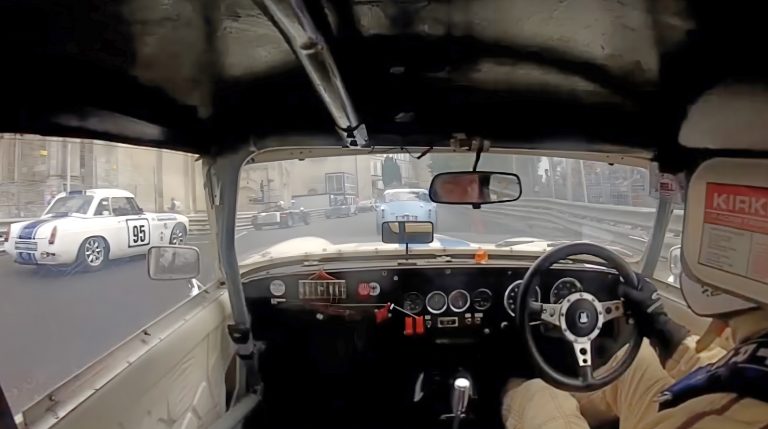
Jon Wolfe’s Triumph GT6 was a renowned, exceptionally quick race car, celebrated for its YouTube fame (see image below) with over 40,000 views and distinguished by outright victories at legendary circuits like the Nürburgring, Nordschleife, Monza, and Brands Hatch. It has a history of class wins, notably in the FISC Euro Tour and CSCC Swinging Sixties championships, and was the winner of CSCC Swinging Sixties Class C in three consecutive years, from 2008 to 2010.
Originally built as a Birkett special, this 1967 Mk1 GT6 evolved over time into a competitive machine with several components from later Triumph models. Although not a concours racer, its reputation is rooted in remarkable speed and ease of handling, having achieved multiple race and class victories.
The car weighs 750 kg without fuel, with a 57% front and 43% rear weight distribution. It features a full race, MASS Racing built engine, including new bearings, oil pump, and oil cooler. Performance enhancements include forged JE pistons, Titan roller rockers, triple matched 45 DCOE Webers, ARP bolts, and a modified big-valve head. Its gearbox is a close-ratio, five-speed Ford Type 9 with Quaife components. The chassis and body have been lightened, with fibreglass panels and polycarbonate screens.
Other features include a Bastuck-cased 3.89 ratio final drive, Quaife ATB LSD, alloy wheels with Yokohama tyres, adjustable Avo shock absorbers, upgraded suspension and brakes, independent rear suspension, a foam-filled 50-litre fuel tank, multi-point roll cage, electronic ignition and rev limiter, 16-row oil cooler, aluminium radiator with twin electric fans, and a host of safety and race-ready equipment such as a Davies Craig electric water pump, stainless steel exhaust, Kirkey seat, Elliot tachometer, Raceparts and Smiths gauges, plumbed fire extinguisher system, FIA LED rain light, new starter battery, leather steering wheel, and full lighting system.
Kas Kastner
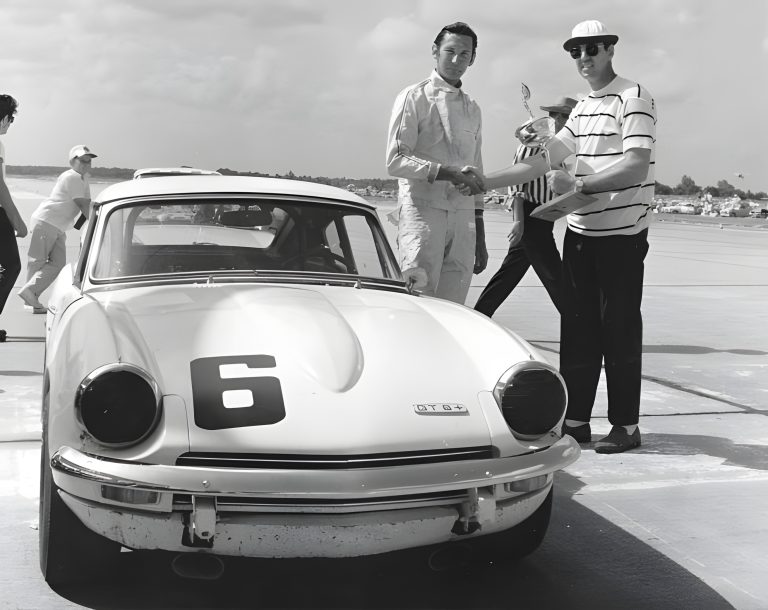
R.W. ‘Kas’ Kastner started the USA Triumph Competition Department for the Triumph factory in the early 1960’s. He authored the Triumph Preparation manuals distributed by the Triumph factory in the 1960 – 1972 era of production car racing. He is well-known for his pursuit of power increases for the Triumph cars with long experience in engine dynamometer testing. Although he resigned in 1970, to run his own company, Kastner-Brophy Inc, he helped Triumph to prepare the GT6 for the Sports Car Club of America (SCCA) class E-Production. The GT6 won the championship in 1969/70, hence the plaques on the dashboard! To visit his own website click on the picture below.
A Kastner-Brophy GT6 Mk3 won two big races in 1972, and the car (see below in period, and in 2016) now belongs to James Dolan. He “bought the car after talking to the seller and it was as advertised. We had a bit of race prep to bring things up to date with new belts, fuel bladder, brakes system rebuild, and we were ready to race. I tracked down Kas Kastner and obtained a lot of history about the car. Kas was a great guy, he told me all about what to look for to confirm it was his prior car. Then we spent a lot of time at the Kastner Cup race telling stories. A real gentleman”.
John Holmes Racing
John Holmes Racing, founded in 1976, specialised in preparing Specialist Performance, Classic and Racing cars of all makes and types, and had workshops in Tattenhall, near Chester and Warrington. In 1983 David Tuck joined the business, bringing his engineering skills and racing experience with both a Van Diemen RF82 and later an ex works Magnum 843.
Looking for a new racing car project, David eschewed the more usual MG or Lotus and decided that a more left-field choice would be the small Triumph GT6, relying on their skill and ingenuity rather than a large bank balance to make the car competitive.
The GT6 was interesting, relatively inexpensive, has a strong and eminently tuneable six cylinder engine, independent suspension all round, light weight and an excellent supply of reasonable priced parts. They were successfully raced in the US, Group 44 winning the US National SCCA E-Production Championship at Daytona in November 1969 (as per the plaque on the dashboard of many GT6s).
David managed to buy a Mk 2 for a few thousand pounds, although they ended up having to go to Cornwall to collect it! Although the car turned out to have a few more faults than they thought (a pitfall of buying unseen) it was totally rust free, unusual for a 45 year old Triumph.
This meant that their efforts could be directed at preparation, rather than remedial welding. They were hoping to enter the 2014 6 hour Snetterton endurance race, but decided instead to uprate the engine to the longer stroke 2.5 (with ARP con rod bolts), and fit a Ford Type 9 5-speed in place of the original overdrive gearbox which turned out to be shot, delaying completion of the car to sometime in 2015.
The final specification depends on the type of races they decide to enter, but at present these will be hose under the auspices of the Historic Sports Car Club. Modifications so far have been mainly to enhance the GT6 as a road car as well as the track. Apart from the bigger engine and 5-speed gearbox they have fitted a tubular exhaust manifold connected to an impressive sports silencer from a March F2. The sump has been baffled.
Stromberg carburettors have been retained, although switching to Webers is under consideration. Ignition is electronic, with a separate ignition switch, starter button, battery cut-off and an electric fuel pump. The rear area under the hatch is taken up by a foam filled alloy fuel tank, bought from Ebay.
The suspension is poly bushed, lowered by the use of height adjustable coils. AVO shock absorbers have been fitted all round, mounted to the chassis. Wheels are Minilights. The short lived Rotoflex drive shafts have been replaced by more reliable CV joints and Lotus Elise wheel bearing assemblies. Brake pipes are conifer tube (copper with a little nickel which is stronger than copper only) and Aeroquip braided hoses. The diff has been replaced by a Gripper type LSD.
The latest modification is a roll cage providing roll-over and side protection. At present the side bars take up the space previously occupied by the doors, new doors (perhaps fibreglass) are needed with the appropriate cut-outs to restore the appearance of the car.
Group 44 Racing GT6+
Sold at Auction by RM Sothebys in August 2012 for $55,000, a record for a GT6. According to the Auctioneers:
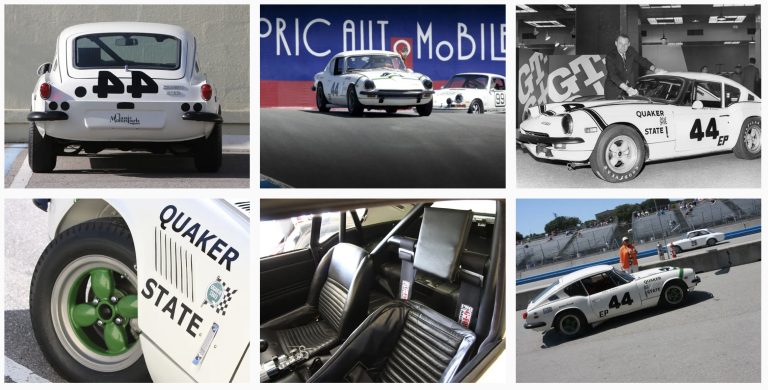
Formed during the early-1960s by Bob Tullius and Brian Fuerstenau, Group 44 Inc. remains one of America’s most successful racing teams, with its cars renowned for their distinctive green and white liveries, impeccable preparation, and countless victories. This ex-Group 44 Triumph GT6+ was driven in period by Mike Downs, Brian Fuerstenau, and Bob Tullius, and secured the SCCA National Championship at the American Road Race of Champions (ARRC) at Daytona in 1969, where the GT6+ swept the E-Production podium. In 1970, this car won the D-Production pole at the very first SCCA Runoffs at Road Atlanta. Sponsored by Quaker State, Champion, and Goodyear, it was also featured in dozens of ads and stories in many event programs and publications, including Road & Track, Sports Car Graphic, and others. It was also Triumph’s display car at the 1970 New York Auto Show. The current owner acquired the GT6+ as a “barn find” in 2005, and Lanky Foushee, the Group 44 Inc. crew chief from 1970 until the team’s disbanding, confirmed its identity. A complete and authentic restoration followed, with the car returned to nearly exactly the way it appeared in the winner’s circle at Daytona in 1969, with careful updates to make it track-ready today. The entire process was carefully documented and covered by Classic Motorsports magazine. In 2009, the car won the Amelia Award at the Amelia Island Concours d’Elegance before participating in the Monterey Historics that August. The restoration was performed to such a high level that former Group 44 Inc. team owner Bob Tullius deemed the GT6+ worthy of his standards when he saw it at the Lake Mirror Classic concours last fall. Perhaps Lanky Foushee said it best recently, “This was the little car that could…until the Triumph TR8 came later, this was my favorite car in our stable. The restoration was great. You guys did a super job.” We could not agree more.
Kevin Ginger
Kevin Ginger was a competitive Triumph racer known for his mid-mounted, highly modified GT6 that dominated races in the late 1980s. He raced with the 750 Motor Club and the Triumph Sports Six Club (TSSC) for several years.
Kevin Ginger was renowned for unusual modification to his GT6—a mid-mounted straight-six engine. Forum posts from the era recall that the radical repositioning of the engine, which greatly improved the car’s weight distribution, made it virtually untouchable on the track. Some speculate the car was eventually outlawed for being too dominant.
During the 1980s, Ginger was a top competitor in the TSSC and 750MC race series. Competitors praised his skill behind the wheel and the speed of his unique GT6. A 1998 race report from Wolfitt Racing details a moment of bad luck for Ginger. His car suffered a severe engine failure—a “golf ball sized hole” in the block—which prevented him from starting the race.
While Ginger’s mid-engined GT6 was one of the most memorable examples of a custom Triumph racer, other enthusiasts have also built high-performance GT6 race cars. For instance, a 1970 GT6 with a modified engine and chassis was campaigned successfully in the CSCC Swinging Sixties championship.
Scott Janzen's 1968 Triumph GT6 Race Car
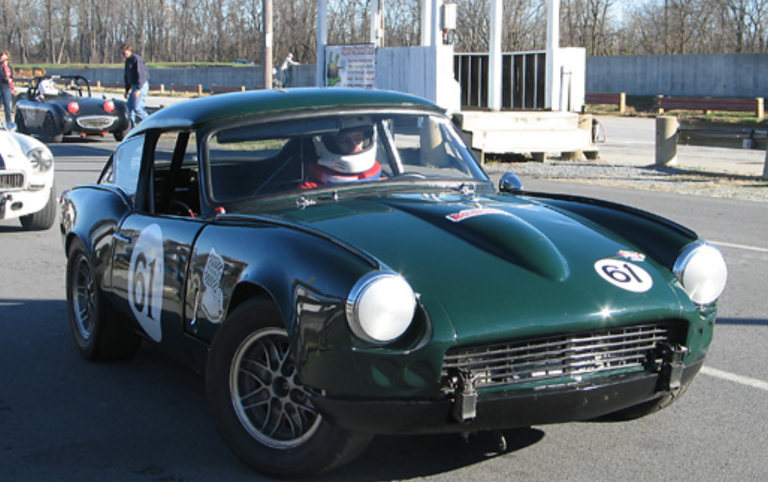
This 1968 Mk1 GT6 possesses a notable and well-documented racing lineage. It began competing in 1972 under Tom Hall in America’s Pacific Northwest before Bill Davis acquired it in 1973 and campaigned at venues like Virginia International Raceway. Davis later lent the car to W. David Bailey, who debuted with it at Nelson Ledges on September 10, 1976. Jim Clipper purchased the GT6 in 1978; during his last event at Summit Point, he rolled the car but avoided serious collision with another vehicle. Its documented racing activities fade after 1981.
In the mid-1990s, Randy Lamp restored the GT6, leaving much of its exterior as is before selling it to John Lehman. Lehman raced the car for three vintage seasons (1997-1999) until his passing. Drew Brown then briefly owned the car in 2002 before selling it to Barry Young, who never raced it and passed it on to Scott Janzen in 2003. Janzen has since prioritised reliability and safety, as seen when the car appeared at Summit Point Motorsports Park during the Vintage Racer Group’s “Turkey Bowl 2009.”
The GT6 sports several performance upgrades. Its engine is a smooth 2-litre unit paired with Triumphtune intake manifolds and triple Weber 40DCOE carburettors. Additional features include a dual-point distributor, custom 6-2-1 exhaust manifold, and a crossflow aluminium radiator with electric fan. The drivetrain consists of a Triumph 4-speed rebuilt with TR7 gears, Hardy Spicer half shafts with full U-joints, and a locked stock differential. For suspension, the front runs standard geometry with chrome molybdenum stub axles and coil-overs, while the rear features Spax shocks on relocated mounts. Braking is via dual Girling master cylinders, front standard calipers, and rear drums. The car rides on Cosmic Mk2 alloys shod with Toyo 205/60R13 tyres.
Electrical enhancements include an alternator and battery in a marine box, paired with a Fuel Safe cell, Facet electric pump, Fram race filter, and Holley pressure regulator. Safety equipment comprises a regulatory roll cage, racing seat with harness, quick-release steering wheel, and a centralized fire suppression system using AFFF.
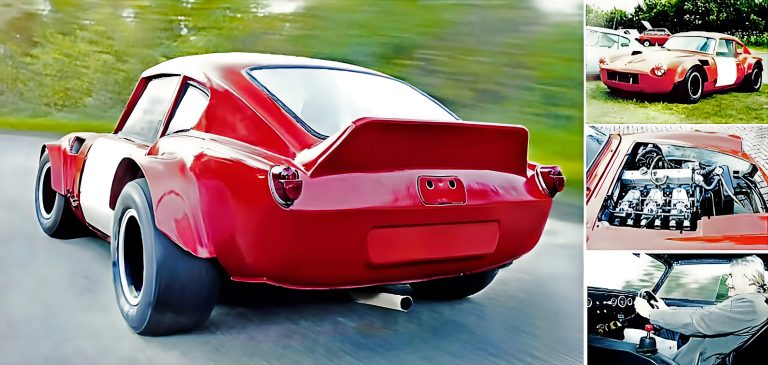
The Williams-built Modsports Triumph GT6
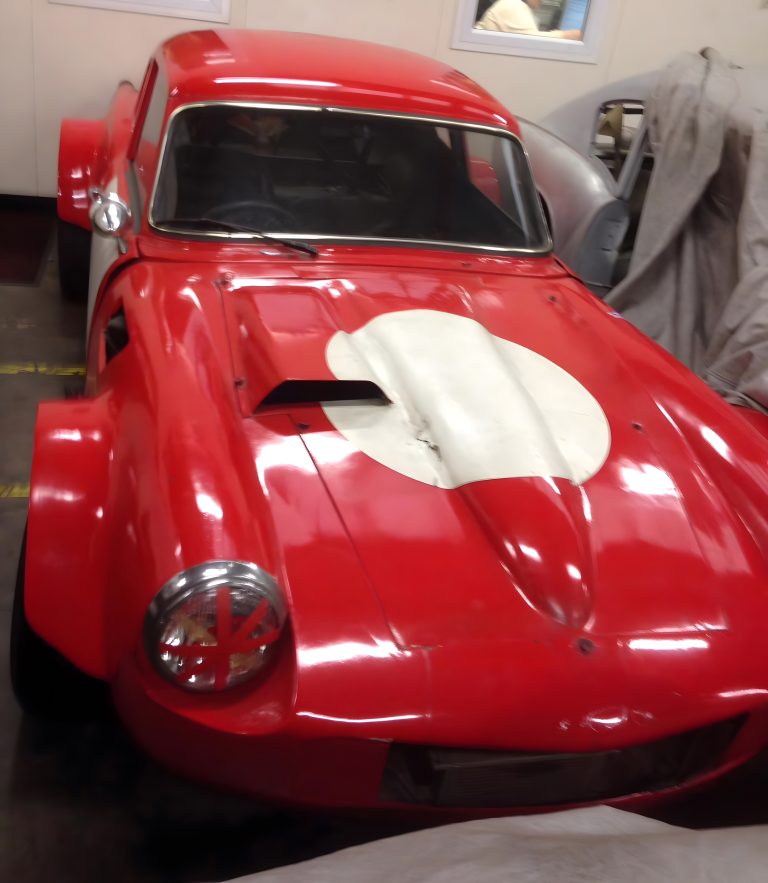
The Williams-built Modsports Triumph GT6 racer, once lost, has resurfaced in Lincoln and is poised to return to competitive racing. Its journey includes original assembly, neglect, restoration, and comeback.
In 1971, Don Loughlin and Chris Williams collaborated to build a GT6 silhouette racer. Loughlin, from Aldon Automotive, recalls their move to Brierley Hill and early development. Williams, a former Triumph engineer, sought Modsports Championship glory, attaching a glassfibre semi-monocoque coupé shell to a Spitfire chassis with a GT6 engine. After initial difficulties, Loughlin converted it to a silhouette racer, repositioned the engine for balance, and upgraded the Triumph straight-six with triple Weber carburettors, a gas-flowed cylinder head, camshaft, and loud exhaust. Rear suspension improvements included custom coil springs and dampers; Williams handled bodywork based on his glassfibre expertise.
Performance improved markedly: Williams placed third overall in the 1972 Modsports Championship and won Class B at Brands Hatch. In 1974, Williams switched to a Jaguar E-type V12 for Prodsports racing as new rules hindered Triumph entries. He sold the GT6 to Duncan Allison, who crashed it soon after; the GT6 was rumoured dismantled.
In 1981, George Woolfenden bought the GT6 for £400, finding it stored dry in a haystack for nine years. Arranged through Allison’s mother at Heathrow Airport, restoration involved sourcing front suspension parts, reinstalling the racing gearbox, and fixing rose-jointed suspension with Rose Bearings’ help. Woolfenden, a nurse, used hospital facilities—including morgue sockets—and preserved the car’s historic scars, restored its red paint, retained rare magnesium wheels, and used stretcher vinyl for recovered seats. Testing occurred discreetly at night around the hospital, earning the car the nickname “The Bitch!” Restoration took two years, but rule changes made it ineligible for formal racing; Woolfenden enjoyed informal track days instead. Eventually, he sold the GT6 to Mark Field in 2010.
Field, co-owner of Jigsaw Racing Services, emphasising authenticity, replaced the steering and rebuilt the carburettors. The car debuted at Race Retro in 2015. Despite offers, Field kept the GT6, aiming to race in the CSCC Modsports series when regulations allow. With renewed Modsports enthusiasm, Big Red is ready for further competition.
The following statistics for the Triumph GT6 are quoted by the Racing Sports Cars website:
To visit the website click here.